By Trisha Bala ’22, News Editor
In the history of the United States, only three presidents have been formally impeached by Congress: Andrew Johnson, Bill Clinton, and now Donald Trump. However, none of these presidents have been actually been removed from office through impeachment. In addition to these three presidents, the only president to face formal impeachment inquiries in the House of Representatives is Richard Nixon, but Nixon resigned before he could be removed from office. Impeachment is a statement of charges leading to a trial. The impeachment process begins in the House of Representatives with a formal impeachment inquiry. If the House Judiciary Committee finds sufficient grounds, then its members will write and pass articles of impeachment, which then go to the full House for a vote. To impeach a president, only a simple majority is needed. This does not mean that if the president is impeached, he has to leave the office. The final stage is the Senate impeachment trial. If two-thirds of the Senate find the president guilty of the crimes laid out in the articles, then the president is removed from office.
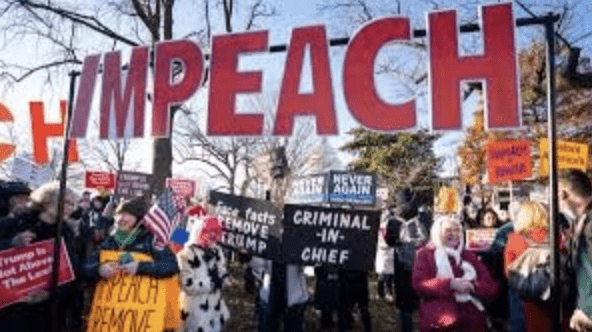
On December 18, 2019, after hearing many debates in the Intelligence and Judiciary Committee, the U.S. House of Representatives voted to impeach Trump on two articles. The first article addressed Trump’s abuse of power as he sought Ukraine’s help for his domestic political benefit (quid pro quo). Trump is accused of pressuring Ukraine to dig up damaging information on Joe Biden (one of his Democratic challengers in the 2020 election) and his son Hunter. Trump is accused of using two things as bargaining chips with Ukraine – withholding $400 million of military aid that had already been allocated to Ukraine by Congress, and a White House meeting for Ukraine’s president. Democrats say that this is an abuse of presidential power, as he used the office for personal political gain and also jeopardized national security. Additionally, Trump is accused of obstructing Congress by not cooperating with the congressional inquiry. The second article addressed Trump’s obstruction of Congress and his refusal to cooperate.
One piece of evidence used against Trump was a formal complaint from a whistleblower. The whistleblower is an unnamed intelligence officer who wrote a letter expressing his concern about Trump’s July 25 call with President Volodymyr Zelensky, the Ukranian president. This kicked off the impeachment process early in September. Additionally, a rough transcript of the call revealed that Trump urged President Zelensky to investigate the allegations against Joe and Hunter Biden. This call occurred shortly after Trump blocked the money in from the U.S. military aid to Ukraine. President Trump denies using military aid as a bargaining chip. He insists that his call with Ukraine was “perfect.” He then called the impeachment inquiry a “witch hunt” led by Democrats and the media.
The next step in Trump’s impeachment inquiry is the Senate’s trial. The Constitution only states that the Senate must have a trial with senators sitting as jurors, house lawmakers as prosecutors, and the chief justice of the U.S. presiding over it; it does not mention exactly how to hold a trial. Rules approved in the 1980s give some guidelines, but the really important stuff is up to the Senate. The only modern guide to an impeachment trial is Clinton’s trial. Clinton’s trial is considered a successful trial as Republicans and Democrats put together the most fair trial possible. It receives the articles from the house, the Senate will agree on a start date. If Trump is convicted of even one count, he will be removed from office, but, many believe that the likelihood of this happening is low. Mike Pence, the Vice President, will take over office if Trump is successfully convicted by the Senate.
Leave a Reply
You must be logged in to post a comment.