By Jackson Powers ‘20, Staff Writer

https://www.wbur.org/news/2020/01/03/u-s-sending-3000-more-troops-to-mideast-as-reinforcements
Are we going to war? Despite the catchy title, honestly, who knows? Are we officially going to war? I doubt it. The U.S has not officially been at war since the days of WW2. We do not declare war anymore. Will we see increased aggression from Iran, putting ourselves at risk of retaliation? Almost certainly, yes. The U.S cannot continue to throw down the gauntlet whenever it wants to assert itself. But throwing down the gauntlet is exactly what President Trump did in Iran. Here is the issue at hand: the airstrike called on General Qassem Soleimani was deemed an act of self-defense by the President. The story as it has been told is that Gen. Qassem Soleimani was in the midst of planning “imminent and sinister attacks” on the U.S, the specifics of which were either not declassified or not known. Should this be true, I believe that the United States not only has the right but rather the obligation to protect itself with a preemptive strike. Unfortunately, it is at this moment absurdly unclear as to whether or not the U.S was in any credible danger. To make matters worse, this “preemptive strike” was as brash and brazen as it could be, given current events. Defense Secretary Mark Esper labeled the airstrike as nothing more than “decisive defensive action”. President Trump himself said that “we took action last night to stop a war. We did not take action to start a war”. On the surface, this airstrike is nothing more than a country protecting its citizens. But the story is much more complex.
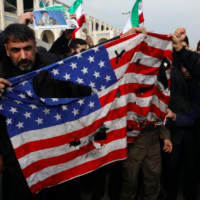
A few days before the strike, the U.S embassy in Iran was overrun with Iranian protests. The danger grew to the point where President Trump sent in marines to secure the embassy. President Trump tweeted that “Iran will be held fully responsible for lives lost, or damage incurred, at any of our facilities.” and that “They will pay a very BIG PRICE! This is not a Warning, it is a Threat.” Tensions with Iran were already heating up. Mohamad Mouhiye, a spokesperson for Kataib Hezbollah, an Iran-backed Iraqi militia, asserted that “This protest was a stand against US political dominance.” I doubt that the timing of the airstrike and the tensions between the two nations is simply a coincidence. Iran has already pledged to enact revenge on the United States. Despite what the President tweets, it does seem as though this strike started a war.
The facts as we know them now are that President Trump authorized an airstrike on a prominent political figure in a country which has had tense historical and recent relations with the U.S. According to the Speaker of the House, Nancy Pelosi, President Trump did this without the consultation of Congress. Less violent actions have been considered acts of war, and it is hard not to see this as one. The protests in Iran were largely focused on U.S aggression in the Middle East, most notably through troop placement and, of course, airstrikes. Killing a prominent, albeit dangerous, Iranian by an airstrike leads me to believe that President Trump either intends to provoke Iran or just does not mind the backlash. What one may call an act of self-defense, another may call a blatant political assassination. That debate is central. The United States has the right to defend itself. It does not have the right to carry out political assassinations to send a message. It is not very clear yet as to which of these two categories the airstrike falls in.
How should the nation react to all of this? I would not rule out another informal war in the Middle East. However, that the U.S will probably not officially sanction war when the airstrike was deemed to be in self-defense. It is also unlikely that this is something that gets swept under the rug. Iran has already lobbied the U.N to consider the airstrike an illegal act of aggression from the U.S, though it hardly matters (The U.S has a history of operating counter to the U.N). The issue at hand is the disconnect between what President Trump preaches and how he acts. He preaches about peace while intentionally or unintentionally taking action that would provoke war with Iran. To be clear, I am not defending Soleimani. Nobody knows what his plans were exactly. However, for a man who tweets about ending wars, President Trump and his cabinet have done a great job of provoking one. As of right now, very few know the scope of the danger Soleimani posed to the U.S and thus cannot judge President Trump’s actions as just or unjust. Who knows what Soleimani’s death protected us from? Hopefully, whatever we have gotten ourselves into will not put American lives to waste. Iran has pulled out of the famous 2015 nuclear deal, something the United States pulled out of last year. The tension is palpable at this point. Who knows if World War Three will ever happen? All I know is that we have another nuclear country to worry about, which is just grand.
Leave a Reply
You must be logged in to post a comment.