By Yasmeena Sharif ’23, News Writer
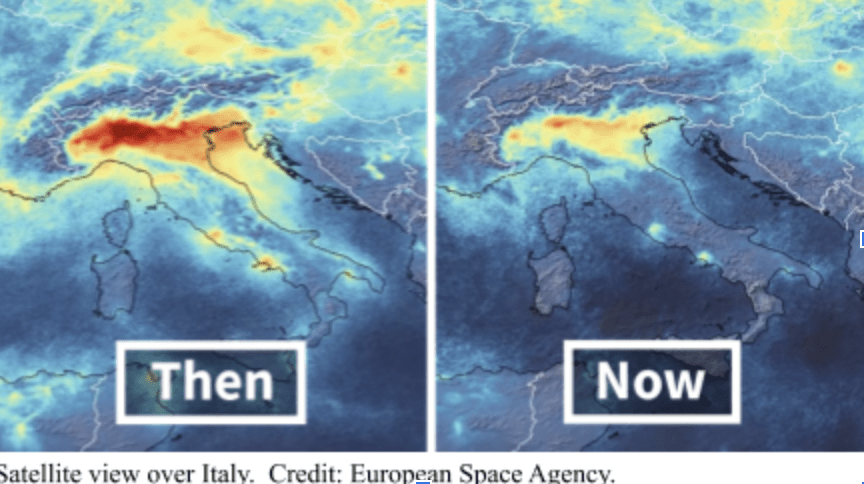
Recently, the virus known as COVID-19 has caused many people to practice self-isolation, or in other words, staying home as much as possible. As a result, the amount of pollution in today’s world has greatly decreased. Because carbon emissions and motorway traffic are falling, the quality of air has considerably improved over the past month or two.
People in countries all around the world are self-isolating, whether by choice or because it is required by their respective governments. Due to people not being outside as much, wildlife is starting to make reappearances in unusual places. Coyotes have been spotted on the Golden Gate Bridge in San Francisco, and deer just a few blocks from the White House. However, this is not limited to just the U.S. In Barcelona and Italy, there have been sightings of wild boar and peacocks. Additionally, goats have been seen in Wales.
The globe has experienced temporary falls in carbon dioxide and nitrogen dioxide by as much as 40% over the past few months. Since air quality has improved, there is a reduced risk of asthma, heart attacks, and lung disease due to air pollution. In fact, the leading cause of carbon dioxide in the U.S., passenger vehicle traffic, is down by 40%, another result of people staying home. Worldwide, motorway traffic is down by 83% and car sales fell by 44% in just March alone.
In Venice, Italy, a city known for its canals and heavy water pollution, the waters are clear. Due to a lack of water traffic, the water is clearer, but not necessarily cleaner. Since motorboats have been grounded, the amount of pollutants and churning of sediment has dropped significantly. This doesn’t mean that the pollution had disappeared, but instead, it is no longer as visible. In fact, the planet is experiencing its first drop in global emissions since the financial crisis in 2008-2009. However, some negative impacts of the virus on the planet include the waste buildup as a result of companies taking preventative measures to slow the virus’ spread. For example, Starbucks is only using disposable cups to help slow the spread of the virus. The cups cannot be recycled. Although Wuhan, China has reopened, when the city was on lockdown, the amount of medical waste quadrupled to over 200 tons a day, causing huge mountains of waste.
That being said, many scientists are expecting many of these positive changes to be only temporary. When the world reopens, it is expected that many of these numbers will shoot up, but will still most likely be lower than they were before the pandemic. The world after the coronavirus will most likely never return to the old “normal”. Although at some point in the future, the world will reopen and business will resume as “usual,” and lawmakers and government officials will be forced to re-evaluate policies as they relate to climate change. For many climate change activists, the hope is that the effect that the coronavirus has had on the planet will continue into the future.
Though the quality of the environment may be improving, it is important to acknowledge the essential workers who are risking themselves and their families in the face of this pandemic. It is important to recognize how important these people are to the fight against the coronavirus and to thank them for their hard work.
Leave a Reply
You must be logged in to post a comment.