
by Michaela Wang ’21, Feature Section Editor
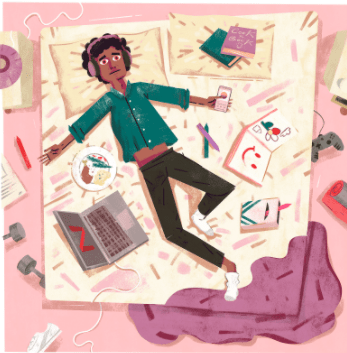
From November 2-3, the Newark Academy community revisited a part of our past we hoped would end last spring: the “join without video” moments, the pajamas waist-down, the chicken nuggets in Enviro class, and the extra hours of the day to take care of ourselves. But a minority of Newark Academy’s students have been learning this way since the beginning of school and through the fall. It isn’t just lunch-time naps and Zoom glow.
The unavoidable issue of having both remote and in-person learning is the inability to accommodate both environments equally. It is virtually impossible for any teacher to simultaneously straddle their attention between the classroom and the Zoom room, meanwhile battling technology problems that often arise. As a result, remote students often struggle to participate in class conversations and feel less able to ask for help.
Lori Hashasian ‘21, who opted for virtual learning as cases crept up in early October, explained: “Last spring, it was much easier because everyone was on Zoom so it was easy to follow discussion. Now, classes are basically being taught for everyone physically at school with remote students having to do their best to follow along.” When “following along” becomes difficult, remote students must find opportunities outside of their class to engage with their teachers.
Especially since Newark Academy’s curriculum is fundamentally based on discussion, the divide between remote and in-person learning stifles collaborative thinking. Lori adds, “It’s definitely tricky because lots of classes at NA are discussion-based so when you can’t hear the discussion, it feels like you’re missing out on a lot.” Equipment such as Owls, webcams, and flat-screen monitors aim to help, but distance nevertheless proves to be a setback.
To counteract physical barriers and avoid succumbing to what he proclaims as “screen zombies,” in-person English teacher Mr. Reed diversifies class activities and innovates ways students can feel more part of the classroom than just on a flat screen monitor. For example, when assigning small group work, he tries not to fall back on the default of clustering Zoom attendees in a pod; instead, he connects each remote student to a rotating cast of in-person classmates. While implementing simple strategies, he also meticulously plans lessons to ensure that classes oscillate between large-group discussion, small-group brainstorming, online poster designing, and writing exercises.
Regardless of learning quality, remote students still cited strains on focus, as they join Zoom class to Zoom class without substantial periods to shift their minds elsewhere; last spring, the synchronous and asynchronous model enabled students to take a breath. Evan Lee ‘23, who opted for remote learning in early November, initially thought that staying at home would give him more time, but soon found himself losing focus and motivation easily.
Another turn-off of remote learning is the lack of genuine social interaction with peers. Classmates can only see each other shoulders-up in little squares, and rarely ever engage in authentic conversation. Keira January ‘21, an in-person learner since September, never contemplated going remote. When asked why she chooses to stay at school amid rising COVID cases, Keira responded, “Being back in the school environment was the best thing for me after 6 months of barely seeing anyone.” While some remote interviewees said that they could thrive without social interaction, others observed that the lack of simple small-talk undercut a feeling of community.
Mr. Reed tries to emulate the middle-of-the-hallway or after class run-ins, by carving out particular times to just ask his online students about the weather, their weekend plans, or any other small talk that often goes underappreciated.
Nevertheless, the question of going to school isn’t just for friends or learning, but health––especially for those with family members in vulnerable populations. Penelope Jennings ‘22 has learned remotely since the first day of school to protect her sister, who is immunocompromised. Additionally, Evan, who sees their 90-year-old grandpa almost everyday, fears that he could catch COVID and transmit it to their already-vulnerable grandpa.
As COVID cases reach new level highs and concerns about in-person learning mount, remote students persevere: at the very least, they can be at home with their families, safely––amid four-day-old clothes and the crude reality of learning, and living, online.
Leave a Reply
You must be logged in to post a comment.