By Katie Powers ‘22, Social Justice Writer
Voter suppression is one of the most large-scale aspects of the systematic disenfranchisement of
minorities in America. In the 2020 election, this took several forms, one significant example being voter registration requirements.
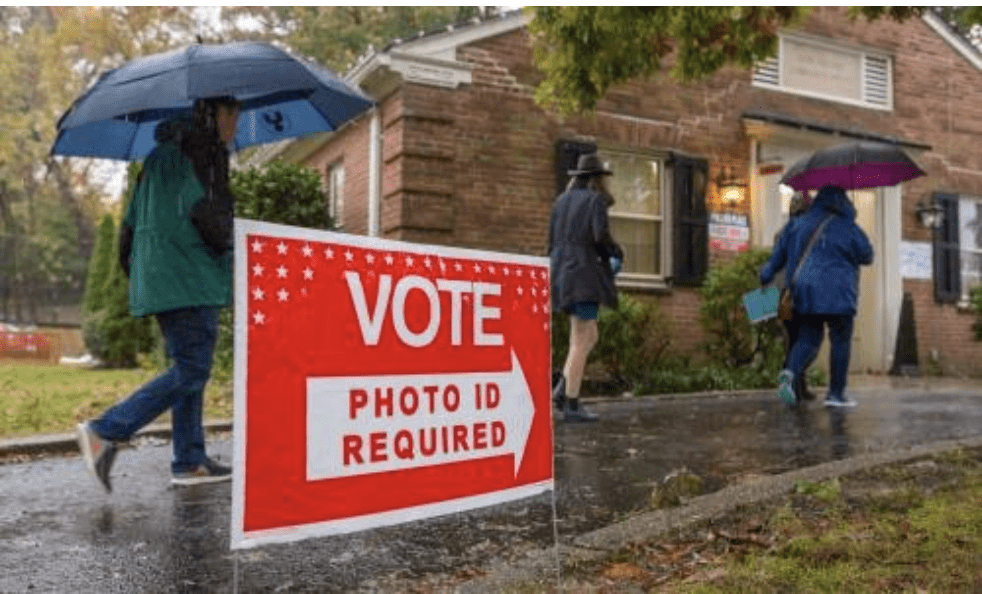
Possibly the highest-impact registration requirement is that of photo identification. Thirty-six states across the country require some form of government identification to vote, with six states enforcing strict photo ID laws. These laws require voters to present a certain type of government-issued photo identification in order to cast their ballot. The issue with this practice is that 21 million Americans do not, actually, have government-issued photo ID. Many forms of ID cost money, and even the ones that are free require the incurred cost of the documentation needed to obtain them. The combined cost of document fees, travel expenses, and waiting time is estimated at $75-$175. This is a large burden on low-income communities, and in fact, the U.S. Government Accountability Office estimates that these laws reduce voter turnout 2-3 percent. This translates to tens of thousands of votes lost in a single state. This form of voter suppression far disproportionately affects minority voters, with a study by the Brennan Center finding that 25% of African-American voters of age lack government-issued photo ID, compared to 8% of white American voters of age.
Signature-matching laws have a similar effect, and were increasingly relevant this year due to the influx of absentee voters under COVID. Signature-matching laws require the witness signature on a voter’s ballot to match that of a voter registration document, driver’s license, or other such documentation. The processes for this requirement vary widely across states, some using software programs, some relying entirely on human judgement, some having single signatures to compare with, and some having many. With the vast disorganization of this process, error is extremely common. Several lawsuits were raised earlier this year in response to Ohio’s voting practices, and a political scientist at Carroll College, working on the behalf of these cases’ plaintiffs, found that 97% of rejected ballots are likely to be authentic. This translates to 32 valid ballots thrown out for every one invalid ballot. In the same manner as photo ID laws, these requirements largely affect young voters, who do not have as precise signatures due to the phasing out of cursive from school curriculums, transgender voters, who are more likely to have changed their names since initially registering, and female voters, who are more likely to have changed their names since initially registering due to marriage.
Beyond signature matching laws, simple mistakes on ballots cause many votes to be thrown out as well, also at higher rates for minority voters. This is due to a combination of systemic and individual factors. There are systemic differences in the information regarding voting processes available in minority neighborhoods, meaning a minority voter may be more likely to make a mistake on their ballot. Simple discrimination is also an issue; for example, non-English ballots are much more likely to be thrown out. Under this combination of factors, the effects are clear. A study by the Stanford-MIT Healthy Elections Project found that Black and Hispanic voters’ ballots were thrown out at roughly double the rate as those of white voters.
These requirements also have a specifically monumental impact on Native American voters, for whom voter turnout is the lowest in the country. Language barriers, lack of access to transportation, and lack of access to mail already make it difficult for Native Americans to vote, and registration requirements only add an extra barrier. A large part of this issue comes from the fact that many Native Americans lack a residential address. This is partly due to high rates of homelessness on many reservations, where housing is often unaffordable. The other reason for this issue is that many Native American’s live in extremely rural areas, where roads are unnamed and often impassable due to storms, meaning the U.S. Postal Service does not deliver mail to these residents’ homes. As a result, many reservation residents get their mail from P.O. Boxes or trading posts. For example, the Navajo Nation, the largest reservation in the United States, does not have an addressing program. Lack of a residential address can cause the voter to be placed in the wrong precinct, have their ID address not match the voter rolls, or they may not receive election mail at all. Many states also require a state ID to register, and do not accept tribal IDs.
These requirements were specifically stressed in this election as a defensive measure against claimed voter fraud. The problem is, there is no evidence of such voter fraud occurring. In fact, state and federal officials released a statement saying, “The Nov. 3rd election was the most secure in American History.” These requirements may exist under the pretense of security, but they merely target and suppress minority votes. It is urgently important that all of our country’s voices are heard. Voting is an absolutely essential part of democracy, and our country must do more to ensure that all our citizens have an equal and fair say in our futures.
Leave a Reply
You must be logged in to post a comment.