By Ava Cole ‘22, News Writer
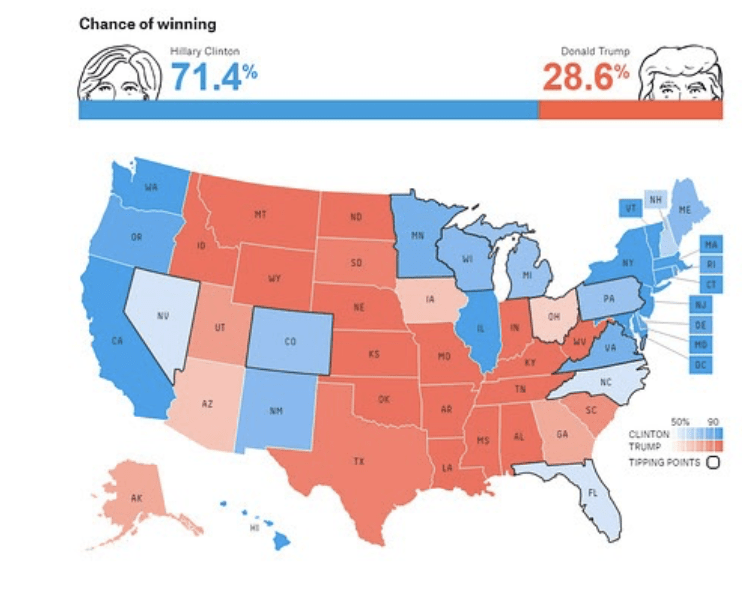
In 2016, America was expecting a historical election–Hillary Clinton was predicted to be the first female president of the United States. She was the obvious choice on paper: former Secretary of State, former New York Senator, and former First Lady. November 3rd came, and America did indeed witness a historical election, but for very different reasons. Against all odds, Donald Trump managed to snag the election and became the 45th president of the United States.
The 2020 election, although a different outcome, was similar to 2016 in one of many ways: Donald Trump had taken the nation by surprise once again. The “blue wave” many analysts predicted was nowhere to be seen. Biden did not sweep the election. Instead, the election came down to a few key battleground states which Trump lost by a small percentage of votes. This pattern begs the question: why was Trump overperforming during these elections? The answer lies in the accuracy of election polls.
In 2016, polls showed an 85 percent chance that Clinton would win Wisconsin’s electoral votes. Similarly, polls claimed Clinton to have an 80 percent chance of winning Michigan. On election night, Trump won both Michigan and Wisconsin, two battleground states that can often decide an election. Fast forward to 2020: polls predicted Biden winning Florida by 6 points, a must-win state for Trump if he wanted to retain the presidency. Once again, the polls were wrong: Trump ended up winning Florida by 3 points. When trying to analyze where exactly the pollsters went wrong, there are several factors that come into play.
One main factor is education: studies show that well-educated voters (those who have gone to college) are far more likely to respond to polls than less educated voters. Why? Highly educated voters will pick up a pollster’s call or answer a survey because they want their opinions to be heard–they want to share their knowledge with the world. Less educated voters, as pollsters have realized, would much rather go through the voting process privately. They are harder to reach through phone calls and often disregard surveys. So, in order to get a real sense of who the population wants to elect, it’s crucial to ensure that both college-educated voters and less educated voters equally take part in the polls. In 2016, the vast majority of voters who finished college or had gotten some masters or bachelor’s degree went for Clinton, and thus the polls were flooded with Clinton supporters.
Another factor is simply the difference in characteristics of those who respond to polls and those who don’t. People who don’t answer polls, according to data analyst David Shor, tend to have lower levels of trust in others. And as of 2016, these people vote overwhelmingly Republican. Both the 2016 and 2020 polls overrepresented Democrats, and thus both Clinton and Biden were projected to win by a large margin.
The last factor, which might just be the biggest influencer, is the pressure from the media and many Americans’ visceral dislike of Trump. The polls do not take into account the idea that a person might be ashamed or scared to admit their support of a candidate. They are what pollsters call the “shy Trump voters.” These voters are less likely to express their political views, whether it be through phone calls or online surveys, because it is generally less socially-acceptable to vote for Trump in many areas of the country. There is no way for polls to account for these voters, which can explain why Trump has done significantly better than any of the polls predicted.
The strangest thing about these factors is that they have only just recently affected the accuracy of the polls. Before Trump, whether or not a voter had gone to college had a much less significant impact on whether or not they voted Democrat or Republican. Polls, up until 2016, had been more or less accurate in their predictions. However, even with the greater reach of technology, election polls have proven themselves untrustworthy these last four years. Were these crucial inaccuracies in the polling system solely dependent on Trump, or have pre-election polls lost the trust of the American people for years to come?
Leave a Reply
You must be logged in to post a comment.