By Kieri Keys ‘24, Arts and Entertainment Staff Writer

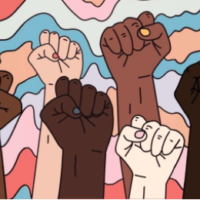
Examples of Black Lives Matter fists, symbol of 2020 movement for POC equality. Credit: Daniela Shapiro
Art, by definition, is the expression of what is beautiful, or of more than ordinary significance, through means of creative human skill. This is not to be confused with craft: the human creation of an appealing product. To simply spawn something from nothing is not enough to be an artist. Pieces that resonate more deeply to an audience are those that come from truth— the truth of the artist’s self or the world. There’s any reason to create something beautiful, but when art is a call to action rather than a want, the entire concept is evolved.
The death of Trayvon Martin, a 17 year old high school student who was shot by a man on February 26th, 2012. His murderer was allowed to walk, free of charge. This injustice was the catalyst for #Black Lives Matter (BLM). A campaign co-founded by three black women made this hashtag to acknowledge people of color after the incident. 8 years later, social activism for the matter reached an all time high. In spring 2020, the inhumane murder of George Floyd took place on May 25th in Minneapolis. It wasn’t the first, and, disgustingly, was not the last death of an innocent Black person at the hands of white police officers. The public outcry came in waves and crashes, even louder than it had before as the people of America bore witness to the reality of systemic racism. This was the return of the Black Lives Matter movement into modern media.
As crucial as it is to listen to POC about POC matters, showing unity within a group of minorities will not make a change. What the movement needed were allies, support, and solidarity across all different platforms of representation. The call for diverse voices revealed the potential for art in its purest form. Unapologetic, uncensored, and imaginative minds brought the Black Lives Matter protests from an outcry, to a sensation. Art became a catalyst for change, an inspiration to contribute, and a crucial method to spread awareness and information.
Pieces dedicated to a body of art in support of BLM range from graphic designs, photographs, choreographed dances, to even mainstream songs sharing experiences and opinions. Musicians like Beyoncé, D’Angelo and Kendrick Lamar have used their platforms and artistic voices to create raw content for their followers. Local governments have started using public displays of art such as murals and sculptures to signify the importance of POC activism. Both state-regulated and unregulated areas have been covered in individuals’ unique graffiti. Cities like New York have undergone semi-permanent additions to their environment, welcoming the trend of street painting. Selected painters like LeRone Wilson of the Harlem BLM street mural designed each letter of a giant street-long artwork to be significant to the culture of Black history, not just letters to drive over. The thought and talent put into murals like these around the country show dedication to a craft and a cause. Up in Oakland, California, sculptor Leo Carson memorialized Breonna Taylor and the BLM movement by taking months to sculpt her out of clay. The symbolism and effort of the sculpture was clear, but its efforts were seen all for nought. Less than two week after installation, the work was vandalised. This crime was an insult to the artist and town of Oakland, who later commissioned Mr. Carson to remake the statue in bronze as a testament to their values.
Sculptures, contrary to paintings, are art in one of the longest lasting forms. Across America they immortalize historical figures in bronze, marble, and gold. They mark a person or object’s contribution and worth to society. Using $20,000 raised by the state to remake the sculpture, Breonna Taylor’s bronze bust will represent this time of hardship and perseverance for the Black community.
The most iconic influence art had on the Black Lives Matter movements was the creation of an iconic symbol for unity- the fist. It’s a clear, simple picture that can easily be incorporated into specific and everyday life. Artists use this in modern social justice art to further associate its image with change. Combining the fist with other oppressed symbols can intertwine the futures and supporters of fellow discriminated groups. For example, Black Trans Lives Matter is an extended branch of BLM with overlapping struggles. Protests with closed fist posters and shirts dominated the media for weeks and weeks on end, creating an image that will live on long after its peak.
The impact art has on people cannot be shown through just one example. Its results differ depending on the demand for creation, as no two original pieces are the same. The Black Lives Matter movement consists of voices that need to be heard and thoughts that need to be expressed. Activists were breaking down and exposing the fundamentals of our country, and to accomplish their goal, they needed unity. Nothing speaks unity louder than the convergence of separate parties into one message, one symbol, and one goal, while keeping their individuality. The purpose of a singular movement isn’t to compress experiences into one umbrella term for injustice, it’s to celebrate the backgrounds and stories that make the chapters of one collective book. That is what art has given the Black Lives Matter movement and other quests for social justice.

Leave a Reply
You must be logged in to post a comment.