
by Juliet Bu ’23
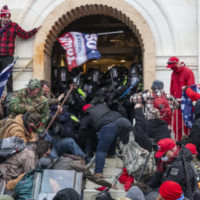
On January 6, 2021, rioters stormed into the capitol building, armed with weapons and destructive mindsets, and dressed in loud, conspicuous costumes. Their choice of wardrobe consisted of everything from star-spangled superhero outfits to a variety of flags (pictured above). Examining the rioters’ attire provides us an important perspective, because the way a group chooses to present themselves shows their intent and the message they want to spread.
First, rioters adorned themselves in red, white, and blue capes and shields, aiming to resemble classic superheroes like Captain America and Superman. In context, these beloved superheroes we grew up with sported flowing capes and omnipotent auras, reassuring us that they would always be there to save the day. We idolized them for their superpowers, their selflessness, and their dedication to justice.
Perhaps, then, the rioters felt that their superhero outfits gave them the power and validation to storm the capitol. However, while determination and selflessness are things people aspire for, computer science teacher, Mr. Alford, questions, “Do people feel so powerless that they turn to mythical images?” In fact, this introduces a larger theme of the riot wardrobe: the harnessing of powerful symbols to substitute for the feeling of powerlessness.
Another trademark of superheroes is that they use their special privileges to protect and establish justice in society. The self-proclaimed “heroes” at the capitol believed that they were preserving the integrity of our judicial system by fighting against election fraud. However, the desecration of an iconic American landmark was not in the name of justice, but a guise for an exasperated expression of anger. A fight for justice means respecting what has been previously defined as just, and defending that. The election has been certified as just, showing that their definition of justice is clearly not paralleled with the country’s definition.
The contradiction continues as we examine the rioters’ most popular accessories, flags.
Ms. Fischer, a member of the humanities department, comments on the often-seen American flag in demonstrations, saying “One of the main things we see… is the idea of patriotism, like the obsession with the flag and everything red, white, and blue.” Ms. Edwards, head of the humanities department, further argues that this patriotism––in the form of carrying flags and destroying a government building––is paradoxical: “Some of [the demonstrators] truly believe that they are the only true Americans and their role is to save America from its corrupt government.”
Along with American flags, the rioters also chose to accessorize with flags representing racial hatred, like the Gadsden and Confederate Flags. The Gadsden flag, with roots from the Revolutionary War, is often seen representing white supremacist groups. The Confederate flag was used to represent the slave-supporting south in the Civil War. The choice to bring these flags reflects the different interpretations of patriotism in the United States. To some, patriotism is respecting the government and having pride for their country. But others, like the rioters, have made it clear that to them, patriotism is preserving the founding values of the country.
However, as Ms. Fischer points out, the Confederate flag was used to represent the Confederacy, a group of pro-slavery states who wanted to, not so patriotically, secede from the United States. The message this sends is that the rioters are defending slavery as part of preserving the “original” America, a belief that is entirely incongruent with the current America.
Besides the Gadsden and Confederate flags, there was also Neo-Nazi propaganda on display. Neo-Nazi propaganda is highly anti-semitic and racist, because it represents the views of Nazis who committed genocide on Jewish people during World War II.
The common theme shared between the Confederacy, Neo-Nazis, and white supremacist groups is the superiority of one group to another, based on race. Ultimately, the rioters claiming these symbols conveys a message of racism, hatred, and hostility. In the insightful words of Ms. Fischer, “If this is their revolution, what message are they sending?”
The next step for America is questioning how to reclaim symbols to erase their harmful meanings. Symbols like Confederate flags and Neo-Nazi propaganda will always represent racism. But, is it possible to redefine the traditional American symbols that represent freedom and liberty? Ms. Edwards answers this: “The optimist in me wants to say that we can reclaim [them] but the realist in me believes that too much violence has been perpetrated under the guise of these symbols for certain groups, like Jewish and African Americans, to ever associate them with anything other than hate.”
Ms. Fischer shares another perspective: “I think if America is willing to take a deep hard look at what patriotism really means, then we can reclaim [them].”
We as a country need to accept that systemic change is necessary, and for change to occur there needs to be respectful discussions and cooperation. In the heated political climate of our society, will we ever be able to harmoniously represent and accept the diverse cultures of America?
Leave a Reply
You must be logged in to post a comment.