By Michaela Wang ‘21, Feature Editor
How to budget or open an investment account are rarely taught at high school. Gen Z and Millennials are flocking to unlikely sources of financial education.
Everyone, at some point in their lives, must become versed in the language of finance––whether our parents teach us how to fill out IRS tax forms for our first ice cream scooping summer job, or our sudden post-grad financial independence forces us into a rabbit hole of investment Youtube videos. At the same time, the complexity of financial jargon (is an ETF an alien spaceship or a mutual fund?) paints an image of exclusivity and haughtiness: finance is meant for corporate bankers, inaccessible to young people and women of color, and completely out-of-reach for those who lack the resources.
A new wave of content creators leverages popular platforms like TikTok, Instagram, and Youtube to teach approachable lessons on finance. On YouTube, monthly uploads of videos on investing increased nearly ninefold between 2013 and 2019 according to data provided by YouTube. TikTok Finance has grown so much that the popular segment has been coined #FinTok or #StockTock. This shows a lot about our internet-bred generation, as we prefer to receive advice from social media than established institutions or bricks-and-mortar banks.
Personal finance influencers lean into memes and popular culture, analogizing financial terms to what’s familiar to their under-25 audiences while inculcating core financial tenets. “Everyone likes memes and no one likes finance,” Haley Sacks, a 28-year-old self-taught investor known as @MrsDowJones, told the Wall Street Journal.
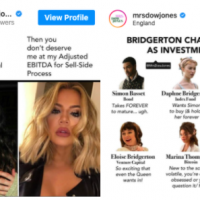
On an Instagram post in 2020, Ms. Sacks humorously compared actual earnings and adjusted earnings to a Khloe Kardashian before-and-after makeover. Recently, she linked characters in Netflix’s Bridgerton show to types of investment; the marriage-resistant duke, Simon Basset, would be the equivalent of a bond, which “takes forever to mature.”


Courtesy of Haley Sacks (mrsdownjones) via Instagram
The short-form style of Tik Tok allows content creators to cram quick investing tips into light-hearted, comedic sketches. To explain the concept of “call options,” “Robinhood Kid,” also known by her username @girltalkstocks, impersonates a shopper looking to purchase a makeup palette that will likely rise in price. The buyer calls Ulta Beauty and pays a non-refundable fee to “hold” the makeup palette at the current price. Once the price rises, the buyer picks up the palette at the lower price, selling the makeup palette on her way out.

Courtesy of girltalkstocks via TikTok
Ms. Sacks believes that the biggest challenge in investment is abolishing the misconceptions of its difficulty. “I think the best news is that it’s not that hard. It sort of feels like we’ve all been duped into thinking that this is so difficult.”
As these content creators grow legions of fans, banks and other sponsors are eager to cash in, offering sponsorships squeezed into a 15-seconds of a TikTok. Bank of America and Wells Fargo are among the top financial companies paying social media influencers for endorsements, according to market-research firm SocialBakers. However, many influencers have been criticized for pushing products at their young audience, whose inexperience and gullibility could spiral them into reckless financial decisions.
Because social media platforms allow virtually anyone to rise in fame, many influencers, who either taught themselves, earned business degrees in college, or worked brief stints at corporate jobs, receive criticism for spreading inaccurate financial advice. In fact, the Reddit page WallStreetBets galvanized thousands of young traders across the world to pour money into GameStop and AMC, without detailing the nuances and risks of investing in already-deteriorating stocks. Some of these teens lost their college savings.
Despite the risks and benefits, the democratization of finance defines Gen Z and Millennial banking. Mutual funds and ETFs are no longer luxuries exclusive to corporate bankers; younger people and women of color are more than ever attaining control over their finances and the stock market.
Leave a Reply
You must be logged in to post a comment.