By Victoria Pevzner ‘24, Arts and Entertainment Staff Writer
What makes a dish great? Is it the quality of the ingredients? The final pinch of spices for flavor? The amount of time it takes to cook? Or, is it the presentation — the way the dish is displayed to the customer?
These questions are central to the art of cooking. Of course, to be a good cook, your food has to taste good, but presentation is what brings your food to life. I believe that therefore, to master the art of cooking, you must also master the art of plating.
When we eat, we use 4 of our senses — seeing, smelling, touching, and tasting. I would argue that 50% of the dining experience is smell, taste, and touch, as the preparation and texture of the food are important. But the other 50% is definitely sight because when seeing a dish that is creatively composed and is appealing to the eye, we are more likely to try it.
In a study by Charles Spence, a professor and gastrophysicist at Oxford University, this claim was put to the test. First, 60 people were given 3 salads. One salad was not plated at all — the ingredients were just tossed slightly, the other was arranged in a neat way, and the last one was beautifully plated to resemble a painting by Wassily Kandinsky. After trying each dish, the people rated each of the salads from best to worst. What the people didn’t know was that the salads had the same exact ingredients, just arranged in a different way. The salad resembling Kandinsky’s painting was naturally rated as the best tasting dish. This is just one of many studies that shows that plating can really enhance our perception of flavor. Even a simple dish can be considered much more valuable and tasty because the creativity that has been put into it is on display.
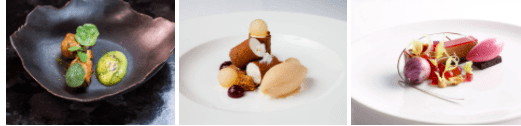
So we’ve covered the significance of plating, but how is it an art? Art is defined in Oxford Languages as a form of self-expression and an “application of human creative skill and imagination”. Plating is just that–a form of self-expression in which food is used. There are many similarities between plating and other forms of art. Some central elements used in plating are also used in painting, sculpting, etc. For example, just like when creating a statue, when you plate your food, you have to be mindful of the height and texture of the dish — these factors contribute to the message that you are trying to convey through the art. These elements will give your dish structure. Additionally, the color palate of the ingredients, just like in paintings, is central to bringing the dish together. Oftentimes chefs will garnish the main ingredients with herbs, fruits, vegetables, or sauces. The colors of these garnishes should work together to create a beautiful color palate on the plate. Finally, a lot of thought should go into choosing the actual plate which you will be serving your food on because it serves as a background. Think of it as a canvas for a painting. Typically, chefs will place more light colored food on darker plates and darker foods on lighter plates to add contrast. There are also many types of plates, such as porcelain, china, wooden plates, stone plates, etc. to pick from. Each of these plates can be styled in different ways so chefs have room for creativity. When all of these elements are brought together, the results are stunning, making people eager to dig in.
By creatively plating their food, chefs create spectacular dishes that many would love to try. This is the factor that raises their food to the next level — the fine dining level. If “[the dish] is beautiful to look at, that’s the best of both worlds,” says Enrique Olvera, the chef and owner of the world-renowned Mexican Restaurant Pujol. Incorporating self-expression into food improves the quality of the dish and creates quite an amazing eating experience for the customers.
Leave a Reply
You must be logged in to post a comment.