By: Mina Ko ‘25, Social Justice Writer
Andrew Milligan/PA Images/Getty Images
From October 31st to November 13, 2021, the UN Climate Change Conference of the Parties was held in Glasgow, UK. This year was the 26th annual conference, known as COP26. Before the summit, 200 countries were asked for their plans on cutting emissions by 2030. The main goal was to continuously cut emissions with the aim of reaching net zero by mid-century. The representatives primarily focused on mitigation, adaptation, finance, and collaboration. During the conferences, those countries revisited climate change pledges made under the 2015 Paris Agreement, which was implemented in COP21. It was a turning point for the climate change movement as every country involved agreed to work together in order to limit global warming to below 2 degrees Celsius and aim for 1.5 degrees Celsius. Countries made national plans, known as Nationally Determined Contributions (NDCs), about how they were going to reduce their emissions which is known as Nationally Determined Contributions. It was important to revisit these plans to make sure they were still relevant, especially because the majority of these commitments will be self-policed due to the fact that only a few countries have legally binding commitments. Due to the Glasgow Climate Pact being delivered, the Paris rulebook was finally completed. COP26’s outcome was significant to many because it was the world’s best chance at climate action and environmental justice.
The COP26 President, Alok Sharma, stated “We must now move forward together and deliver on the expectations set out in the Glasgow Climate Pact. It is up to all of us to sustain our lodestar of keeping 1.5 degrees within reach and to continue our efforts to get finance flowing and boost adaptation.” A central aspect of COP26 was encouraging climate justice in order to aid countries heavily impacted by climate change as well as socially and economically disadvantaged communities. A resolution was that £100 million was donated to the Climate Adaptation & Resilience research framework programme (CLARE). Funded by both the UK and Canada, CLARE will research innovative solutions to help 5 million of the world’s most vulnerable people in environmentally dangerous areas to adapt to climate change. £10 million from the UK as well as $3.5 million from the US were donated for the Least Developed Countries (LDC) Initiative For Effective Adaptation and Resilience (LIFE-AR).
Although many solutions were implemented, none directly addressed the issue of refugees displaced due to climate change. Andrew Harper stated that the UNHCR was concerned that COP26 did not outline concrete actions in this area that would be essential to protect vulnerable communities around the world and avoid devastating consequences for millions of refugees, displaced and stateless people. In order to address these issues, mitigating emissions, increased funding, and support for adaptation would be extremely helpful.
While the annual Conference of the Parties is subject to criticism from the public, there were a few breakthrough cases along with the Paris Agreement. During COP23 in 2017, the Koronivia Joint Work on Agriculture, or KJWA, gave a solid plan to address issues related to agriculture. The solution was a series of international workshops on these issues. This plan was later revisited at COP26, and by that time, three workshops had been held. Due to the opinions of international organizations and governments, the outcomes were considered successful, and agreements were reached in all of the workshops. After revisiting COP23’s resolutions, the representatives later agreed to make a final decision on agriculture at COP27.
However, there is also the question of whether or not the outcomes and solutions of COP26 are feasible. Antonia Gawel, deputy head of the World Economic Forum, stated that “commitments can only take us so far. Impact is only possible if each initiative is actioned”. Change will only be possible if these countries take accountability for their commitments. This does not look promising. During COP15 wealthy countries pledged to deliver $100 billion annual contributions in order to aid developing countries. In 2018, only $78 billion out of $100 billion was donated, along with $80 billion in 2019. This broken promise has led many to question the integrity of the commitments made at the conference of the parties.
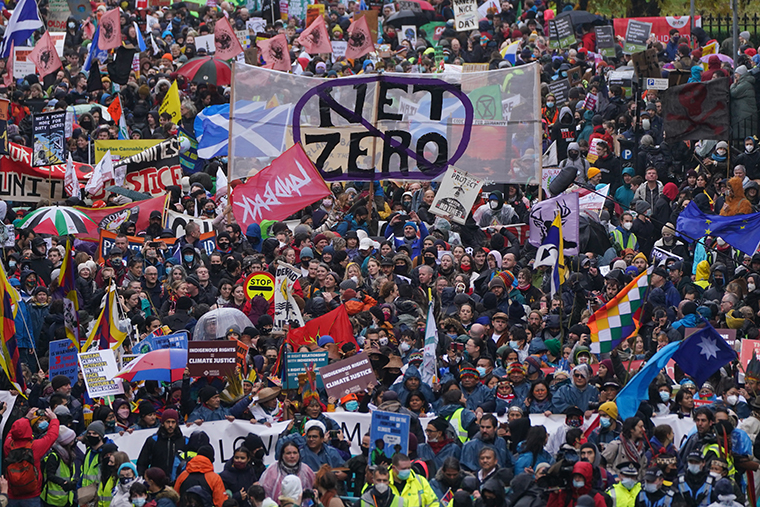
During COP26, more than 20,000 delegates from nearly 200 countries discussed issues on climate change. It was one of the first in person large-scale gatherings since the start of the Covid-19 pandemic. Thousands of citizens as well as activists protested in the streets of Glasgow during the two-week span. There is great significance in so many leaders gathering despite political differences in order to discuss this global issue. COP26 was also the first time nations updated their plans to limit emissions since the Paris agreement. The majority of the general public consider COP26 a ‘fail’, however some still maintain optimism for COP27 which will be held in Egypt 2022. Although there still is hope, there is also urgency; as the executive director of the UN environmental programme Inger Andereson put it, “Climate change is no longer a future problem. It is a now problem, the clock is ticking loudly.”
Leave a Reply
You must be logged in to post a comment.