Jayden Zhou ‘23, Sports Writer (March 2022)

Founded in 1894, the International Olympic Committee set out “to build a peaceful and better world in the Olympic Spirit which requires mutual understanding with a spirit of friendship, solidarity and fair play.” The Olympics are inspired by the ancient Greeks and were created, in part, to bridge the political gap between countries through sports. The Games began as an amateur competition between countries but gradually evolved into an elite-level competition that allowed professional athletes and foreign coaches to participate. This gradual escalation of The Games has not only made it more economically attractive for coaches and third parties but has also entertained the use of The Games as a political vehicle, valuing gold medals as global status. Countries such as China, USA, and Canada have taken advantage of the capitalist nature of professional sports to persuade athletes from other countries to play for them, hoping to win more gold medals and elevate their status internationally.
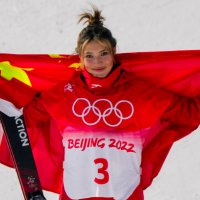
During the 2022 Winter Olympics in Beijing, multiple countries did this, but one of the most notable examples was China’s acquisition of Eileen Gu, a dual citizen of the United States and China. Eileen’s mother was born and raised in China and moved to the States to attend college at Auburn University. Eileen, on the other hand, was born and raised in San Francisco and did not become naturalized as a Chinese citizen until 2019.
Although some may argue that her decision is rooted in patriotism, the economic opportunity that China’s mass-market presents is impossible to skip over. In fact, CBN data, a Shanghai-based research firm, estimates that in the past year alone, Eileen has earned over 200 million yuan, equivalent to 31 million USD, from brand deals alone. Her endorsements include Estee Lauder, Victoria’s Secret, Tiffany & Co., and Oakley, which have all targeted the Chinese market in recent years. In the past few months, American media has consistently critiqued her decision to compete for China, labeling her as a selfish traitor who abandoned her birth country. However, while it is easy to blame Eileen, China’s gold medal seeking policy may really be the problem.
Eileen publicly stated that her decision to play for China was to serve as a role model for female athletes in China and raise awareness for the sport; however, China’s men’s hockey team emphasizes a pattern of naturalization in Olympic sports. Fifteen out of the 25 athletes on the team are naturalized citizens, and of these 25, only 11 are of Chinese descent. Some members of the team are children of recent emigrants, but overall, the team’s ancestral linkage to China is weak. Similar to Eileen’s situation, both the hockey team and China vouched for this arrangement. However, China’s decision to recruit foreign athletes using their economic prowess as a marketing tactic is not only politically questionable but goes against the Olympic spirit.
In the Olympic results, China managed to edge out the United States in gold medals 9 to 8, two of which came from Eileen. China’s focus is especially on gold medals; this year, they earned 9 gold medals, 4 silver medals, and 2 bronze medals. This uneven distribution is uncommon and shows their priority for gold.
China was not the only country to recruit from overseas, and while it is unfair to single them out, they are a great example of how the Olympic Games have become a political tool for governments to demonstrate their status in the world. Therefore, while the Games’s evolution over the years can represent a positive change that inspires competition within sports instead of on the battlefield, it also undercuts the Olympic spirit’s genuity and contaminates the authenticity of the Games with political agendas.
Leave a Reply
You must be logged in to post a comment.