Nicole Pevzner ’28, Sports Editor
The loud blare of an alarm clock echoes through your room. You slip out of bed to turn it off; looking out the window, you see that it is pitch black outside. You throw on some clothes and briskly walk to practice. It’s 6 a.m. You yawn but push through, realizing you have a long day ahead of you: classes, practice, studying, and bedtime at an ungodly hour.
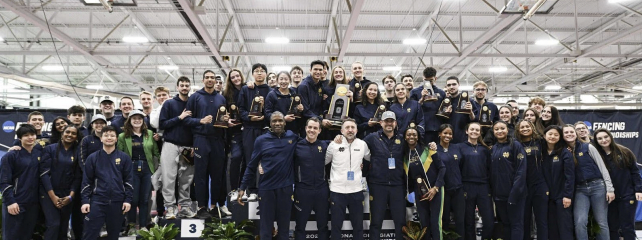
This is the life of a student-athlete. For some, it may seem impossible—but NA alumni Jenna Shoman ’24 and Victoria Pevzner ’24 make it happen. Both are Division I fencers. Jenna fences for Harvard University and helped her team place third in the NCAA Championship, while Victoria contributed to the first-place University of Notre Dame team.
Outside of college, both alums have competed on the U.S. National Team. In April 2025, Victoria and her teammates secured the World Championship title in Wuxi, China.
A commonly overlooked aspect of student-athletes is how the skills they develop transfer to career success. I had the opportunity to catch up with Jenna and Victoria upon their return home from college and asked each of them which crucial skill, learned through competitive athletics, now applies to their professional development.
Jenna believes resilience is the most important skill. “Sports teach you to keep pushing forward even after setbacks, which is essential for success in any field,” she says. Resilience is not only vital for career success but also an essential skill we rely on at NA. For example, if we don’t receive the test grade we expected, instead of giving up, we can meet with teachers to review our mistakes and learn how to prepare better next time.
Victoria, on the other hand, emphasizes accountability. “In a team environment, you’re not just representing yourself—you’re representing your teammates,” she explains. “If you make a mistake, it’s your responsibility to own it, learn from it, and move forward.” Being accountable for one’s mistakes is a sign of maturity, and acknowledging errors is the first step toward what Victoria calls “embracing the process.”
In many careers, producing work and receiving feedback from colleagues is unavoidable. Readily accepting suggestions and recognizing that mistakes are part of growth are invaluable skills. As students, we must practice this mindset as well—taking feedback from teachers and peers constructively in our daily lives.
In a highly individual sport, both Victoria and Jenna agree that being a supportive teammate on collegiate and national teams has contributed greatly to their personal growth and career development. “I started thinking less about my own self-doubt and fears and more about how I could lift up my team, represent my school, and compete for something bigger,” Victoria says. “Once I began focusing on the team’s success rather than the much smaller weight of my own results, I became both a better athlete and a better person.”
This shift in perspective extends beyond athletics into career building. Learning to prioritize team success over individual achievement connects to other activities Victoria participates in, such as business clubs where collaboration is essential for projects and presentations. Many of these experiences mirror what students are taught at Newark Academy, showing that teamwork applies to all stages of education and life.
Jenna adds that “many job recruiters appreciate the dedication and teamwork that come from being a student-athlete.” The workplace values student-athletes because they have learned to handle responsibility under pressure.
While balancing athletics and academics requires hard work, discipline, and resilience, the skills gained through the process last far longer than a single season. They prepare student-athletes to face challenges, embrace responsibility, and thrive in their careers and lives beyond school.
Leave a Reply
You must be logged in to post a comment.