By Rahul Kaul ’12, News Editor
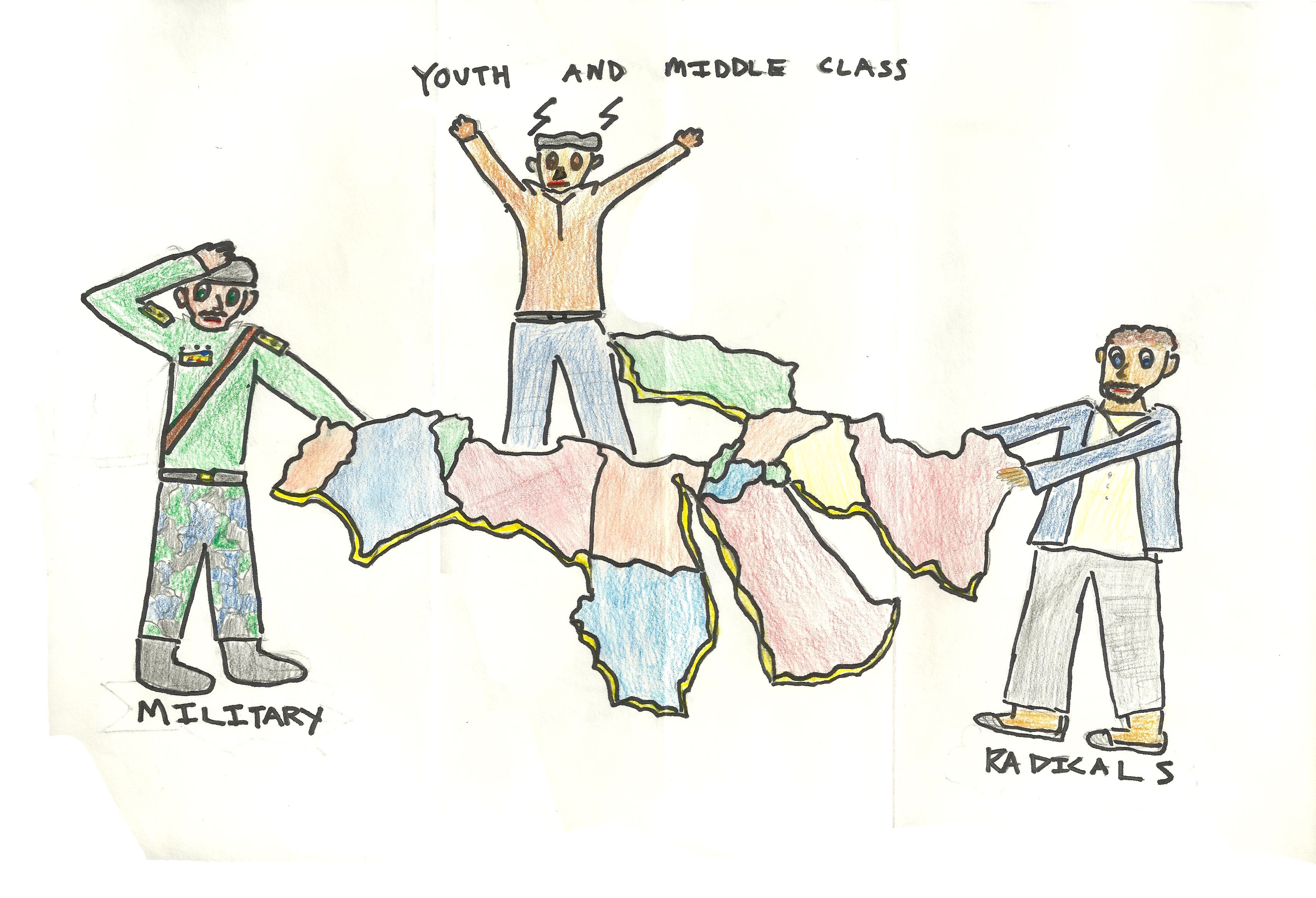
They’ve certainly been in the news, the protests-turned-revolutions in the Middle East, where in the oppressive nations of the region, entire societies have kept the fire of revolt – ignited by Tunisian self-immolator and street vendor Mohamed Bouazizi on December 17th – alive . But where can we find the significance in them? Certainly the citizens of Morocco, Algeria, Tunisia, Libya, Egypt, Sudan, Jordan, Syria, Lebanon, Iraq, Yemen, and Iran have recognized their thirst for democracy, but how will this change the face of world politics, and the lives of these enraged Middle Easterners? To find out, The Minuteman asked Humanities teachers Mr. Parlin, Mrs. Schottland and Mr. Abbey about the short- and long-term causes and effects of the recent events in the Middle East, events whose impact will reverberate through history. [1]
On the issue of potential democracies in the region, Mr. Parlin explains how “it seems very difficult to create a democratic state out of nothing,” since “democracy rests on faith.” He comments, “If I don’t like the President of the United States, I have the absolute confidence that in four years I will have the opportunity to remove or vote against the President. [I have] absolute confidence that the people in power won’t kill me.” He highlights Turkey as an example of an eventually “moderate, secular, democratic regime” where citizens “still have the right to practice religion.” On a street in Istanbul, Mr. Parlin describes, you can see “women dressed in the most conservative style and along will come a woman dressed in a modern business suit. Then, a college girl in jeans [will pass by].” Thus, in the Middle East, “the objective [of a revolution] might be to get rid of somebody,” but then there’s a “tremendous task ahead to create a new system.”
Similarly, to Mr. Abbey, “people who start revolutions have certain goals and ideals in mind [but] more often than not leadership fails and the radicals seize the day,” as in Iran in 1979. (Iran incidentally witnessed protests in June 2009 because of such a radical government.) Such radicals might include the Muslim Brotherhood in Egypt. Even with Internet firsthand accounts, however, we must largely rely on reports made by the media on the issue, and the Muslim Brotherhood may very well not even have significant support in Egypt.
Mr. Parlin notes that the “news media loses [its] attention very, very quickly” and that on the specific issue of the violence in the Middle East, “we should become familiar with news sources without a short attention span,” such as Al Jazeera. He emphasizes that Americans should follow the news of “new government systems emerging [in the region], of international relations between [those] nations, and of the existent and potential sources of oil.”
For example, he informs the Newark Academy community that on February 23rd, the price of oil in the international market jumped hugely, and the American Stock Market dropped 200 points, since “the bulk of [US oil] comes from Middle Eastern countries.” Mrs. Schottland, Politics of Change teacher and NA’s virtual expert on Middle Eastern politics, recounts how “for the last forty to fifty years, [the US] has supported autocratic dictatorships in the Middle East for [its] own purposes.” These purposes include guaranteeing a steady supply of oil and ensuring the security of American strategic ally Israel. She admits that “because of the reality of maintaining oil fields and strategic bases,” the US often has “to compromise [with its ideals], as every nation does.”
Though the issue of oil was not yet so dominant in politics during the eighteenth, nineteenth, and early twentieth century, the revolutions during these time periods may share similarities with current happenings in the Middle East. Mr. Abbey refers to the French Revolution of 1789, the revolutions of 1848, and the Russian Revolution of 1917. Whether seeking liberty and equality or a representative republic, the initially moderate revolutionaries were left with the Reign of Terror in France, a Bolshevik dictatorship in Russia, and “right back where they started” in Germany of 1848. As for definitively predicting the unfolding of the events in the Middle East, Mr. Abbey warns that “there’s really no way to know what’s going to happen.”
Mrs. Schottland agrees, taking into account Saudi Arabia’s role in the geopolitics of the Middle East. She describes how though “the House of Saud has been a great friend to American oil companies,” this ruling family has had “an abominable record of human rights violations” and has aligned itself with Wahabi clerics to create an autocratic, theocratic Saudi Arabian monarchy. To her, Saudi Arabia, the “big daddy” of the Middle East, which influentially houses the two holiest cities in Islam, is “the biggest country to be put in jeopardy” by the tumultuous times of late. She holds that the wisest course of action for Saudi ally America is “to continue to not sway one way or the other on the issues” in the Middle East.
Fortunately for those in the United States, the country’s “history is very rare” since “within one generation [of overthrowing the British] an extraordinary generation of human beings created [a] very effective government, ”as Mr. Parlin stresses to the utmost. Mr. Abbey accordingly points out that energetic youth groups in the Middle East will not necessarily bring prosperity and freedom to their nations, as in the case of China’s Cultural Revolution, Pol Pot’s movement in Cambodia, or the Hitler Jugend. Searching for an adequate way to illustrate this notion, he turns to the ominous notion that historian Hannah Arendt asserts in The Origins of Totalitarianism: “Every society has barbarians at the gate—We call them the children.” One must remember, then, that both the Molotov-cocktail-throwing, protesting youth in Tahrir Square and the American, college-visiting, preparatory school student both hold immense power in steering history, for better or for much, much worse.
[1] A simplified breakdown of the events that stimulated the Middle Eastern protests since December 2010:
In Tunisia, President Ben Ali fled to Saudi Arabia on January 14th. In Egypt, meanwhile, where the severely deflated official unemployment level was reported at 10% by the Egyptian government, three-decade long dictator Hosni Mubarak eventually handed off power to the nation’s army on February 11th. For eighteen days, the world witnessed the protests and clashes in Cairo between what were believed to be Mubarak’s supporters and the ‘pro-freedom’ Egyptians, although even this may be a generalization. Similar days of “Revolution Against Torture, Poverty, Corruption, and Unemployment,” as some Egyptian protesters named their Facebook event in January, sprung up in the aforementioned nations of the Middle East.
In this second wave of anger, Shia-Sunni animosity has further complicated the issue in Bahrain, while stubborn and merciless Libyan “Colonel” Omar Gadaffi’s desperate attempt to hold power has been replicated by governmental forces in Iran. In Algeria, President Bouteflika will soon lift the nation’s emergency declaration (reportedly in an effort to stop the protests), while Yemeni President Saleh is stalling university protesters. All the while, the largest Arab nation in the region, Saudi Arabia, witnesses the chaos around it.
Leave a Reply
You must be logged in to post a comment.