By Rahul Kaul ‘12, News Editor and Alex Serratelli ‘12, Staff Writer
On Thursday, February 24th Newark Academy hosted Dr. Hassan Abbas as its third Global Speaker of the school year. Dr. Abbas is an expert on the conflict in the Middle East, with a focus on the Afghanistan-Pakistan region. He is the author of the 2004 bestseller Pakistan’s Drift into Extremism: Allah, the Army, and America’s War on Terror, where he detailed the adverse effects that American interventionism has had in Pakistan. Due to his advanced knowledge of Middle Eastern politics, he has appeared on CNN, BBC, and many other leading news organizations. His presentation to the NA
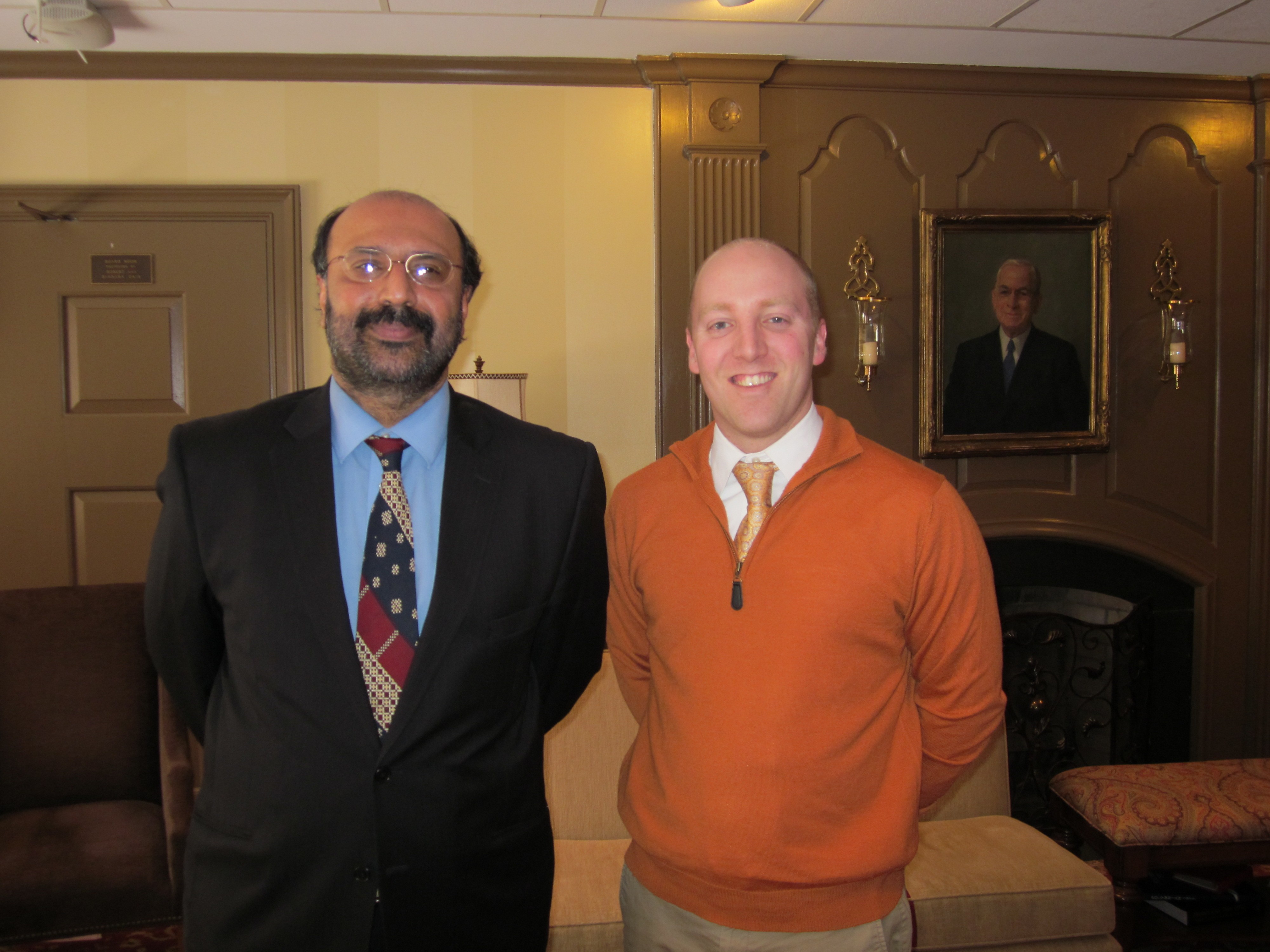
community was titled “Insurgency, Terrorism and Conflict in the Afghanistan-Pakistan Tribal Borderlands.” During the speech he focused on the complex causes of the conflict and offered a solution to quell the violence in the borderland. He colored his presentation with various jokes and anecdotes of his experiences in the Pakistani police force.
Dr. Abbas maintained throughout his introduction that “whenever there is a conflict or violence, there are always two sides to the issue,” mainly “those involved [in violence], and the victims.” Through a variety of diagrams and photographs, he outlined three basic factors that have contributed to terrorism in the Afghanistan-Pakistan border region: geography, history, and current global leaders.
Regarding the first factor, which is a combination of geography and ethnic groups, Dr. Abbas stated that in multi-ethnic Afghanistan, “people might at times feel loyal to Kabul or stuck between their loyalties to other countries.” To him, “ethnic diversity” “ is a “tricky phrase,” since “it is a positive aspect if a nation is wealthy, [but] it becomes a problem with economic [stress].” He recounted a pursuit of a car thief on the Pakistani border. While searching for the thief, he inadvertently crossed into Afghanistan. There, Dr. Abbas gained invaluable knowledge regarding Pashtun tribal culture, all in the house of the father of the thief. After commenting on many similar experiences, Dr. Abbas cited an OXFAM poll, in which ordinary Afghans cited poverty and unemployment as the catalyst of the conflict in the region.
As for the second and third factors, history and global leaders respectively, Dr. Abbas pointed out that in the 1980s, The New York Times portrayed many antagonistic Afghan leaders “as heroes.” To him, during the period of 2001 to 2004, the United States had a chance to start five- to ten-year personal development programs in Afghanistan. Instead, the United States’ attention was diverted to the wars in Iraq. Dr. Abbas accordingly expressed his view that “in the near future, the US government must ask itself whether there is a serious threat for which [it is] spending billions of dollars.”
 Some students, such as Freshman Jordyn Norris, feel that such comments in Dr. Abbas’s presentation were “somewhere in the middle of his own opinion [as well as objective] since he blamed the US and his country of birth for the many issues of today.” Others, like fellow Freshman Vivek Amin, reflect on the presentation as being “an update on what’s happening there,” specifically in terms of the “tribes on the border.”
After identifying the causes of violence in areas such as the Afghanistan-Pakistan tribal borderlands, Dr. Abbas offered possible long-term solutions to end the violence in the region. He asserted his firm belief that “injustice, illiteracy and hopelessness causes conflicts.” He has a two-part solution: creating democracy and establishing educational institutions. He described how “thirty to forty years of conflict and war left the social fabric, educational institutions, and political fabric of Afghanistan destroyed.”
As is often the case, Dr. Abbas thrived in the intellectual environment of the many break-out sessions that followed his morning presentation, answering questions in much greater detail than in his formal presentation. When asked by The Minuteman whether democracy and education have had any actual positive effects in turbulent regions, Dr. Abbas spoke of one example in particular. He made the claim during a break-out session that the United States’ toppling of Saddam Hussein’s regime was “an excellent thing” and that just a few weeks ago, upon revisiting Iraq after fifteen years, he observed “a well-equipped and well-trained Iraqi security force.” He also observed “improved infrastructure” and schools without the “narrow curriculum of the Saddam era.” Most importantly, to him, he stated that “both democracy and education go hand-in-hand, and both take time.”
Despite Dr. Abbas’s clear expertise on the constantly changing topic, some members of the Newark Academy community expressed slight dissatisfaction at the format of his formal presentation. Junior Tucker Iverson, for instance, feels that “even though it was interesting, Dr. Abbas’s presentation was more of a lecture.” Senior Zach Shinkse shares a similar mixed reaction, stating that although he “was updated on the issue” by the “engaging speech,” he found Dr. Abbas’s speech didactic – it was “a teacher teaching a student [rather than a dialogue] with the audience.”
Despite such criticisms, however, it is undeniable that Dr. Abbas successfully raised awareness of the growing conflict around the Afghanistan-Pakistan border through a mix of anecdotes, statistics, and reports on his own research. Students and teachers alike reacted relatively well to his presentation and asked provocative, intellectual questions throughout Dr. Abbas’s visit. We are very grateful to Dr. Abbas for spending his time and sharing his wisdom and experiences with us, and we look forward to the final two Global Speakers of the 2010-2011 school year.
Leave a Reply
You must be logged in to post a comment.