By Elizabeth Vogel ’13, Staff Writer
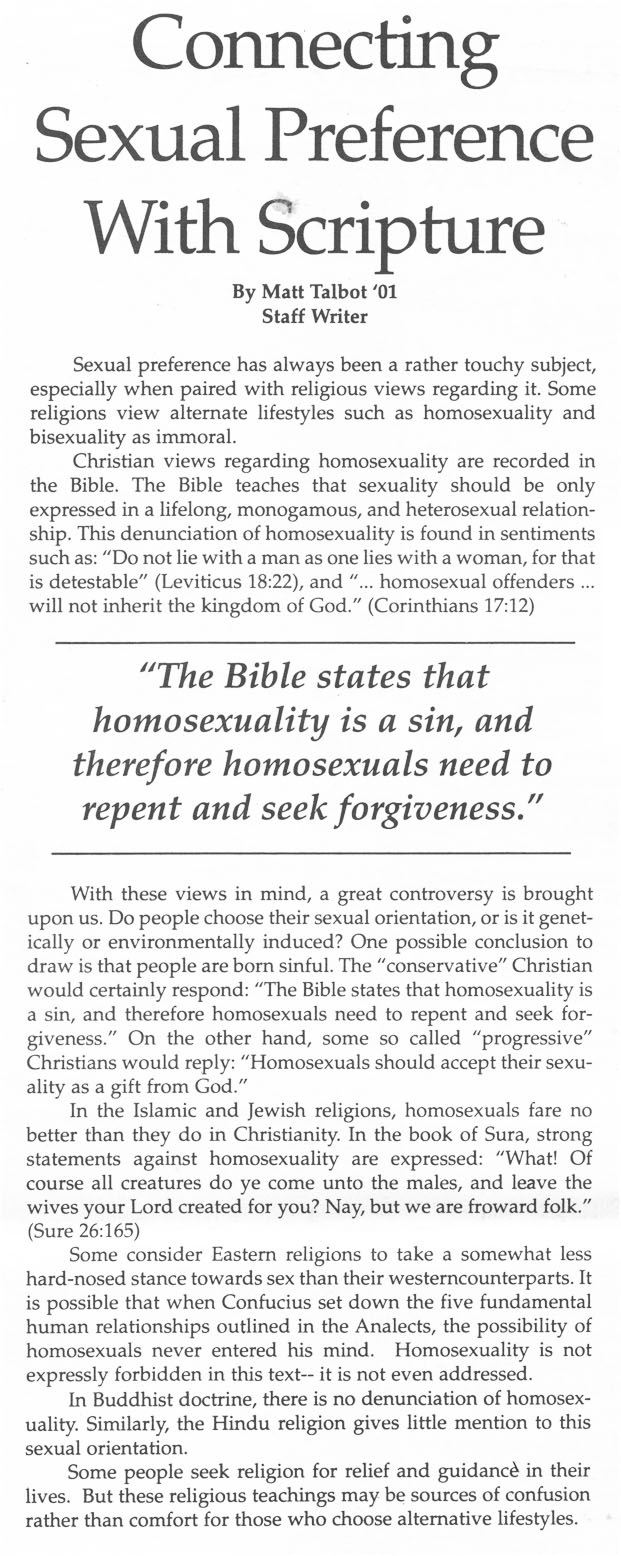
In a 1998 issue of The Minuteman, an article was published with the intention of revealing more about peoples’ opinions concerning homosexuality in reference to their religions. The article cited various religious texts as having explicit anti-homosexual sentiments. While those texts have not changed, many other things have. One of the most visible and advertised changes would be the legal right for same-sex couples to marry.
There are currently six states that will grant marriage licenses to same-sex couples, the closest to home being New York. According to a poll taken by Quinnipiac University, 78% of New Yorkers who said they have no religion supported gay marriage, while Jewish New Yorkers supported the bill 67% to 30%, white Catholics were split 48% to 48% percent, and white Protestants did not support the bill 54% to 40%,. There are two important things to note about this data, the first being that the percentages offered do not add up to 100. It is possible that some of the people chosen did not wish to reveal where their support lies. The matter of homosexuality as related to religion is an extremely sensitive topic for many people, something one should always consider before broaching the subject. This data also excludes several major religions and ethnic groups. As with everything else, these numbers should be taken with a grain of salt.
A more reliable source of information might be the voices of NA. A poll conducted by the Minuteman revealed that of twenty students with ten different backgrounds, seventeen supported gay marriage. Interestingly enough, many students are not sure about their religion’s opinion on homosexuality. For one student, gay marriage seemed to be an issue of national freedom: we live in America and are supposed to have certain rights. Many students also felt that if one does not like the idea of gay marriage or homosexuality, they simply need not take part. One student explained their choice simply: you love whom you love and you should be able to marry that person. The students who did not support gay marriage did not condemn the institution either. For two of those students, religion did not play a vital part in their decision. For the third, religion was the reason for their decision.
Personally, I do not affiliate myself with one religion, but I do feel a strong resonance with Zen Buddhism, which I learned about extensively during my immersion experience. To fulfill my immersion requirement, I lived for three weeks at a Buddhist monastery in New York state. While there, it was my experience that Zen is open to people of all sexual preferences. Many different views on sexuality were represented through the residents of the monastery; we were free to discuss sexuality and its role within our lives. Homosexuality did not seem to be an issue, as long as you were respecting yourself and others as per the Precepts.
Clearly, many things have changed since 1998, but many obstacles still stand in the way of individuals hoping to embrace all sexual preferences and find refuge within the religion of their choice. Perhaps the next step to take in order to encourage freedom of practice and of sexual preference is education. Someone must step up and answer questions such as ,“what does my religion say about homosexuality?” However, our generation must also answer questions for ourselves. If my religion does not support homosexuality, do I have to agree in order to believe in God? The answer is different for everyone, as it should be. The final question must be answered by everyone in this country: how do we come together and make a well-informed decision that works for everyone and every lifestyle?
The Quinnipac University poll can be found at http://www.quinnipiac.edu/x1318.xml?ReleaseID=1618
Leave a Reply
You must be logged in to post a comment.