By Rachel Dechiara ’13, Arts Editor
Last week, I was lucky enough to get a chance to interview Clara Mooney on her title role in the upcoming Fall Drama, “The Diary of Anne Frank.” Here are some of the most memorable excerpts:
RD: Tell me about your vision of the role of Anne Frank.
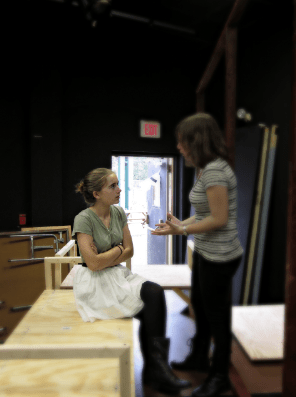
CM: Anne is actually a pretty typical thirteen-year-old, I think, at least the way I’m trying to play her. Probably with a little more spirit and a little more honesty. She’s very high-energy and very curious, interested, and happy to be doing whatever it is that she’s doing. But, you know, part of what’s really central to the play is the fact that she grows up throughout the play. So, by the end, she’s matured into … a very perceptive sixteen-year-old. It’s all about her growing up.
RD: How are you preparing for the role?
CM: I’m doing different things. I had my sister read all of Anne’s lines. I forgot how unaware thirteen-year-olds are. I’ve also been doing a lot of, you know, reading lines out loud to myself and trying them different ways and just really, really looking at the script a lot.
RD: How important are characters’ relationships in the show?
CM: Tucker Iverson [Mr. Frank] and I actually sat down the other day with Mr. J and discussed the relationship between Mr. Frank and Anne, which is another crucial aspect to the show. The way that that these two characters related to each other was very important to Anne and that’s made very clear through her diary and through her words. Making that as authentic and as real as we can is something that we really want to do. And this isn’t just with us, but with every actor in the show. You know, thinking about those relationships when we’re just in rehearsal.
RD: Anne is obviously a very complex role, what are some challenges you’ve faced?
CM: Well, Mr. Jacoby decided to do the piece in the round [audience-members on all four sides]. It’s been difficult, honestly. I’ve never worked in the round before and it’s new and it’s interesting. But it’s really difficult because, as actors, you’re trained never to have your back to the audience and that gets totally erased in the round. It’s impossible to find a moment when you’re back isn’t to an audience member. What the problem is now, is that it just doesn’t feel natural yet. But I think we’ll get there, because people want to get there. But right now it still feels very awkward. Especially once we’re off book and we’re much more comfortable with what we’re saying, I think it will be much easier to move around naturally.
RD: To what extent are you considering the historical context in your development of the role?
CM: What’s hard about this play is that people think of it as being a play about the Holocaust, and in certain ways it definitely is. But what we’re really trying to do in this play is reflect the experiences and the lives of these people who were sort of thrown together to live together. While the Holocaust is always present, it’s really not at the forefront of what Anne is thinking about most of the time. I actually feel that I almost have to work against it in a way, because it’s really easy to fall into the trap of knowing what’s going to happen and thinking about that. But that’s not what Anne is thinking about, and she doesn’t know what’s going to happen to her. She’s really hopeful about her fate, and [showing] that optimism is more of a challenge.
RD: How much has the structure of the secret annex (the small, hidden apartment shared between two Jewish families) impacted your version of the piece?
CM: The style set [in the round] that we’re doing and the space that we’re working in, which is also really small, has become very cramped in blocking very quickly. And that rings very true to what these people were actually living through and the space that they were working in.
Leave a Reply
You must be logged in to post a comment.