By Ethan Andrzejewski ’13 and Ned Harwood ’13, Staff Writers
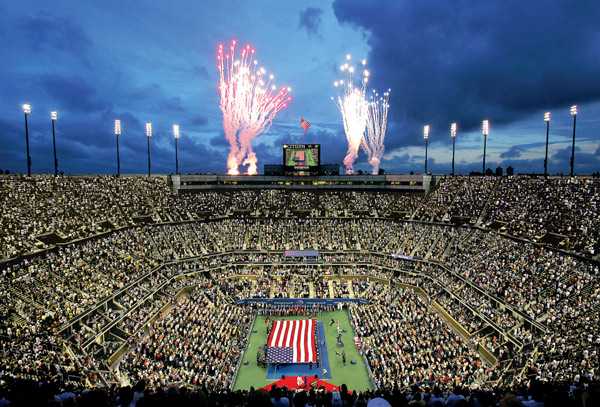
Drifting auburn leaves are jealous. Even the most conclusive symbol of fall doesn’t quite mark the end of summer as well as the U.S. Open in Queens. The Flushing Meadows Classic has graced the metropolitan area for decades and provides a culturally-driven, athletically excellent, and unique experience that is unrivaled among major American sporting events. The U.S. Open is just minutes away from the merriment of Times Square, and smack dab in the middle of the tennis hub that is the Northeast. And it is not just the location that makes the U.S. Open so special. Flushing Meadows also contains the historical Arthur Ashe Stadium, a myriad of stores, and the type of food you would never dream of finding at a sports tournament. Although the facilities may draw thousands to attend the annual event, there is something that is clearly holding the U.S. Open back: the failure of local players. Where are the Americans? That’s been a question raised by tennis fans for way too long.
With names like Pete Sampras, Jimmy Connors, Andre Agassi, John McEnroe, Billie Jean King, and Chris Evert, American players have been ingrained in tennis lore for decades. But in recent years, the game has taken on an increasingly European hue. Women like Belgian Kim Clijsters and Russian Caroline Wozniacki are dominating the WTA, and the men’s side contains a top heavy bubble of Spaniard Rafael Nadal, Swiss Roger Federer, and Serb Novak Djokovic that refuses to be burst. It can be said rather confidently, that with the exception of Venus and Serena Williams, American players have almost no bearing on the global game. That was epitomized this year at our nation’s championship.
Of the notable American men at the Open, ninth-seeded Andy Roddick lost in the second round, veterans James Blake and John Isner were done after the third, and youngsters Sam Querrey and Mardy Fish exited in the fourth. The U.S. men had at least one quarterfinalist at their home major each of the first 41 years of the Open era, but a futile 2009 Open broke that record, and the 2010 Open followed suit.
The U.S. Open is not the only event where American players have struggled. In fact, this season will go down as the worst for American men in Grand Slam events. They had only one quarterfinalist at the four major tournaments: Roddick, in a disappointing one at the Australian Open. On the women’s side, the loss of Serena Williams to a recent injury meant that only two American women were able to make it to the third round of Grand Slam events this year: Beatrice Capra and semi-finalist Venus Williams.
So now the question is, with America’s declining influence on the international tennis scene, does the future hold promise? Thankfully, the answer is yes. Hotbeds for tennis are sprouting up all over the nation, whether it be in schools based on the most refined technical practices, or in programs being developed by some of the United States’s most heralded retired pros. The star power and celebrity that the sport’s most valued members have achieved , regardless of their nationality, continues to breed popularity for tennis. Soon, the event that this nation runs so well will be the site of a well-deserved American breakout. There is a light coming.
Leave a Reply
You must be logged in to post a comment.