By Victoria Pevzner ‘24, Arts and Entertainment Editor

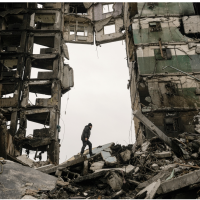
Borodyanka, Ukraine, on April 5, 2022. Image courtesy of Vadim Ghirda/AP Photo
In recent months, we’ve seen the media flooded with photographs from the war in Ukraine that capture the damage that Russia has inflicted on the country. We’ve all seen photographs similar to the one above which feature seemingly apocalyptic scenes of demolished buildings, soldiers in combat, or families trying to escape the conflict. These photographs have been bringing our attention to the horrifying effects of the war by showing us the vulnerability that civilians and soldiers currently face. However, in the past, photographic evidence was not always immediately available, so many people were oblivious to the lasting trauma that came as a result of war. But, as photography became more widespread, people truly began comprehending the realities of conflict.
The development in the common perception of war began as a result of the work of Mathew Brady, one of the most well-known photographers of the Civil War. Through his photographs of post-battle scenes — which revealed the atrocities the South committed during the war — he sought to show the effects of conflict on the American population. In capturing this damage, Brady was able to employ photography as a tactic of propaganda; his images, which were often gory, made the Southern militia seem like monsters to Northerners, because the Northerners were able to see the war-crimes they committed. According to Robert Wilson, the author of Brady’s biography, these photographs “marked a turning point in the portrayal of war”, because prior to Brady’s photos, wars had been greatly romanticized through artistic media and literature, art forms that did not truly capture the horrors of the battlefield. However, Brady’s work contradicted these common beliefs and forced people to finally comprehend the tragic effects of war.
Another well-known war photographer is Robert Capa, whose work documents the Spanish Revolution and World War II. Arguably his most famous shot was “The Falling Soldier” which displays the death of a young soldier from the Spanish loyalist militia by gunshot. This picture had an impact on people because although it seems bloodless, it elicits shock and eeriness through the vast landscape that seems to reduce the power and control of the soldier. The photograph also evokes a sense of isolation and the possibility of dying alone on the battlefield, as the soldier is the only subject in the frame and seems to be quite far from civilization. In an interview, Capa said, “No tricks are necessary to take pictures in Spain. You don’t have to pose with your camera. The pictures are there, and you just take them. The truth is the best picture, the best propaganda”. By documenting the death of the soldier, Capa was able to illustrate the true emotions that soldiers face during a war which can be used as propaganda to change our perspective on it.
Mr. Worrell, Newark Academy’s photography teacher, highlighted the ways in which photographers take pictures of war, and what they choose to include to best convey their message. He gave the example of his good friend, photographer Chad Hunt, who has made three trips with the US Military to Afghanistan as an embedded photographer. Hunt described his goal as “captur[ing] the day-to-day life of the soldiers stationed there, and … help[ing] tell the story of an often-overlooked war.” One of his most notable photographs, “Medic Under Moonlight”, accomplishes his goal through the positioning of the soldier in front of the daunting landscape, making him seem powerless and isolated. By encapsulating these emotions in his work, Hunt is able to convey the true experience of a soldier.
Today, photography continues to be a way in which the realities of war are exposed to the public, a prime example being the war in Ukraine. In the past year, more attention has been brought to this conflict as a result of the photographs being taken there. The photographs, which explore the vulnerability of the subjects and the tragedies that they have to face, create sympathy in viewers to encourage efforts to support Ukrainians. Oftentimes, people who are not directly affected by a conflict do not pay much attention to it, or even dismiss the atrocities occurring in that area. But with the help of photography, the realities of war will not be ignored, and actions can be taken to provide support for those affected by conflict.
Leave a Reply
You must be logged in to post a comment.